
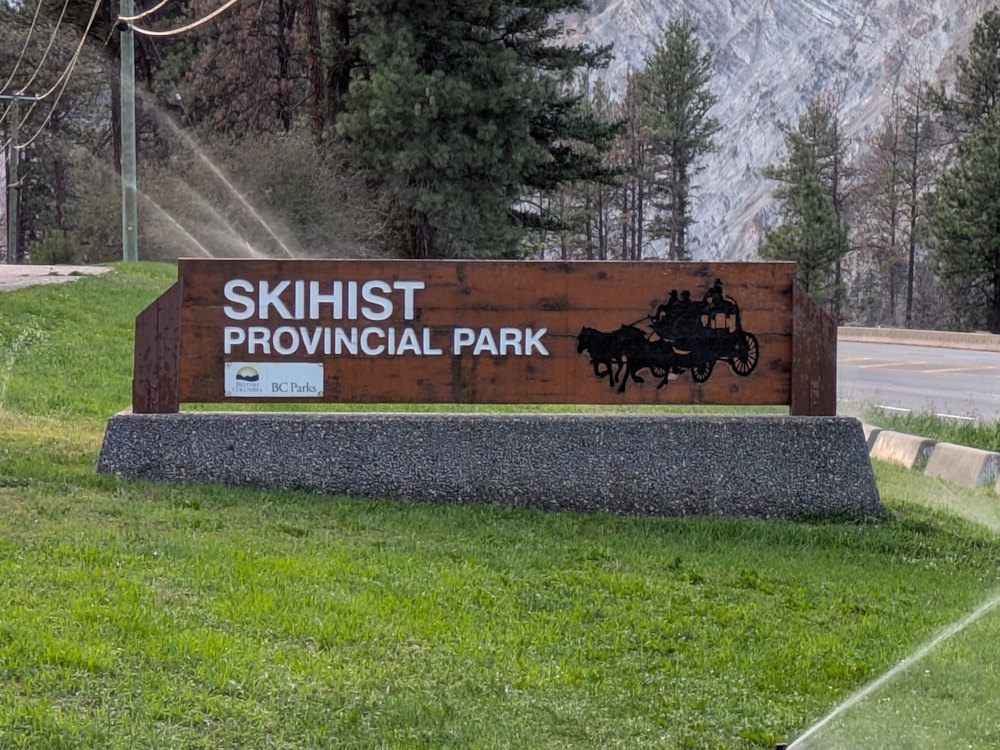
The inevitability of change is something we accept, if begrudgingly. Its occurrence in real time is often unsettling and frustrating. But when we encounter evidence of it in the past it’s hard not to lose ourselves in wonder of what once was. That’s where I found myself during our one-night stay at Skihist Provincial Park.
Prior to September 1987, getting to the lower mainland via the TransCanada was a tedious drive once you got west of Kamloops. While visually appealing, the mostly two lane highway through the Thompson and Fraser river canyons was a congested nightmare, especially during peak summer travel season.
That began to change when the Coquihalla Highway opened in 1987 offering a high-speed, multi-lane shortcut from Kamloops to Hope. The altering of traffic patterns accelerated further with the removal of tolls in 2008. While this significantly reduced congestion on the TransCanada, it left a lot of infrastructure underused.
The effect of this can be seen in the boarded-up restaurants and defunct gas stations in small towns that once thrived on an endless stream of summer traffic. Or the unexpected amenities and shrinking day use area at Skihist Provincial Park, hinting at a former glory.
If that wasn’t bad enough, summer wildfires, an ever-present threat, devastated the nearby town of Lytton in 2021. That fire also damaged Skihist Provincial Park, resulting in its closure until the summer of 2024.
We camped here in 2025 and while scars remain, it is evident that the campground was not destroyed in the fire. A small blessing, that, because it’s a lovely park along a beautiful stretch of the Thompson River. It’s a pity fewer people are experiencing it.
Skihist Provincial Park Location
Our annual summer gold panning adventure takes us into the Fraser Canyon on purpose. No bypasses for us, thank you very much. One of our regular stops on these trips is the Lytton Recreational Panning Reserve. Previously we’ve hit up this panning reserve for a few hours and then moved along but this past summer we decided to spend a night camping nearby. Depending on how you define “nearby”, the available camping options are limited to one: Skihist Provincial Park.
Much of Skihist Provincial Park is located on the south side of the TransCanada Highway ten kilometres east of Lytton, BC. An associated day use area is found on the north side of the highway. In addition to the highway, both CP and CN rail lines run alongside the Thompson River.
These are the last few kilometres of the Thompson River before it joins the Fraser River, and its narrow valley is both rugged and beautiful. Accordingly, three kilometres west of the park you’ll find Kumsheen Rafting Resort which offers white water rafting on both the Thompson and Fraser. Our focus was firmly on the yellow metal, but I have to think these rafting excursions would be exhilarating.
Campground Setting and Layout

Skihist Provincial Park and the campground within reside in a pine forest on the north side of a modest mountain. Forests in these parts are somewhat sparse and patchy even without wildfire damage. Impacts of the 2021 fire can be seen in the campground where trees are blackened but otherwise remain alive. The far west side of the campground shows more severe damage.
The campground consists of a series of switchbacks meandering up the hillside from the highway. The first two switchbacks include the entrance facilities but no campsites. Heading westward out of the second switchback, the campsites begin and cover both sides of two lazy loops forming a misshapen figure eight.
A handful of sites on the west end of the campground offer some sweet views of the mountains rimming the Thompson canyon in the distance. This view has been enhanced by the fire scar west of the campground which has removed a significant number of trees that would have previously disrupted the view. None of the campground is especially ugly, but if you can snag a site with an enhanced view, I recommend it.


Campsite Types at Skihist Provincial Park
According to the official BC Parks website, Skihist Provincial Park is home to 58 campsites. The official campground map on said website only shows 56 campsites. Reading the website dialogue, which discusses recent post-fire upgrades, I suspect the map is outdated and that the 58 site number is accurate.

Of those 58 campsites, 4 are walk-in sites that only allow tents. All four of these are found near the beginning of the first loop and are numbered in the single digits. The remainder are back-in sites suitable for anything from tents to large RVs.

Most of the sites are quite large with long, gravel drives and are fairly level. We chose one of these ourselves despite only having a tent to set up. It could easily have handled a large trailer or motorhome.
All sites are unserviced. If you’re lucky, it’ll be peaceful but there’s always a chance of generators.
Campsite Amenities
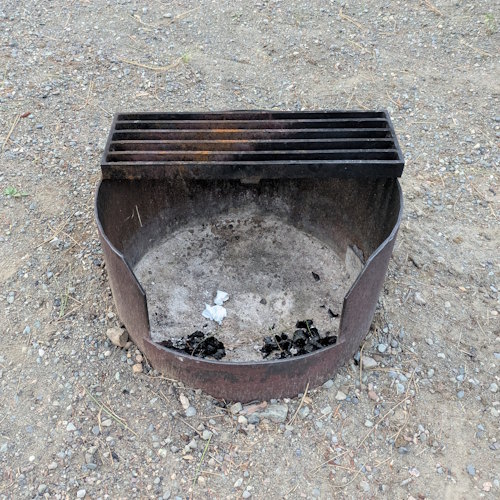
Each campsite is adorned with the usual BC Parks amenities. There’s a steel firepit with a stationary grate covering almost half the surface and picnic table.
If there were any post-wildfire upgrades, it didn’t include modern, movable picnic tables. These are the classic stationary concrete with thick wood tops and seats that BC Parks is famous for. Sturdy though they may be, I wish they could be moved to where I want them. Ah well, it worked great for a single night of tent camping.

Campsite Privacy and Noise
Privacy was hardly a concern as there were very few campers anywhere in the campground when we stayed here. That said, if it were to fill up, do not expect visual privacy. Pine forests in semi-arid climates just don’t have thick underbrush to eliminate views from neighboring sites.
The majority of campsites aren’t terribly crammed together, so this is somewhat of moot point. One or two are quite isolated, in fact. But there are also a couple site pairings that I’d consider close, almost doubles. Of course, being a FCFS campground, you do have some control on finding a spot without immediate neighbours (fingers crossed it stays that way as newcomers arrive).

Your odds are high, based on our experience. We were at Skihist Provincial Park on a Saturday in late July and I’d estimate maybe 10 sites were being used. I found that both surprising and sad. It’s a lovely spot but obviously the impact of new traffic patterns coupled with the closure after the wildfire has greatly impacted the popularity of this park and campground.
On the other hand, the reduced traffic makes this a rather peaceful place. You will hear highway, of course, but at night it’s not crazy busy anymore. I’m sure it was at one time. You can hear the faint roar of the Thompson River in the distance, but this is often drowned out by the constant chirp of crickets. Seriously, the sounds of Nature get quite intrusive through the night.
Registration, Campground Host, and Firewood
There is a campground operator “living” on site. Judging by the golf car with cleaning equipment on board, they’re focused on keeping the campground neat and tidy. And while not advertised as a host, they’re around for help if needed.
However, with no staffed office at Skihist Provincial Park, it’s up to you to self-register. All sites are first come first served and based on our experience there shouldn’t be much difficulty snagging one for yourself.
The only hassle with self-registration is that the registration kiosk is located near the entrance and with the entire campground built up the slope of a mountain, it requires a walk down to the kiosk and back up. Depending on where your chosen site is located, this can be a rather taxing walk. Or, like me, you can be lazy and drive down and back.


In July 2025, the cost of a site was $23/night. You can pay with bills in the provided envelope and later the campground operator will come by your site and leave the appropriate change. We didn’t actually see them do this; there was just a twoonie left on our picnic table when we returned from gold panning in Lytton.
The campground operator also offers firewood ($12/bag in 2025) for sale. Be aware, however, that fire bans are common and lengthy in this part of BC. Considering recent history, this should come as no surprise. The fact there wasn’t a ban during our one-night stay was a small miracle.
Toilet Buildings at Skihist Provincial Park
Perhaps I’m getting a tad hyperbolic about the unexpected perks of Skihist Provincial Park, but I truly didn’t anticipate large bathrooms with flush toilets here. I’m certainly not the most traveled BC Parks camper, but from what I have seen it is a rarity for a park like Skihist to have flush toilets. That being said, I’m all for it!
There are four toilet buildings in the campground plus a fifth in the Day Use area. A pit toilet accompanies each toilet building suggesting it wasn’t all roses since the park’s founding.


Interiors vary a bit. There is a men’s side and a women’s side, of course. The toilet building nearest our campsite had a single sink with mirror bookended by two toilet stalls in the men’s. To contrast, the men’s room in the entrance toilet building included a large stall and a urinal alongside a single sink and mirror. This entrance bathroom is described as disabled access on the park map and the stall within is certainly larger than those in the campground proper.
None of these toilet buildings are new and despite their cold, concrete interiors they are clean and do the job intended. Sinks have a single faucet, so don’t expect hot water. And the front of the bathroom near our campsite had a boil water notice posted on the wall between the doors.
Dump Station, Potable Water, and Garbage
For those using onboard facilities, Skihist Provincial Park has one dump station located near the park entrance, just off the highway. It can be found in the paved parking lot across from the previously mentioned entrance toilet building. It doesn’t look like much and is most certainly dated, but it is also apparently free of charge and handy for those with RVs because there isn’t much alternative in the area.

Drinking water is abundant around the campground, but with a catch. There are several old-school, brown water sources, typically next to bathrooms. I’ve seen these around several BC Parks campgrounds, they have a tap on the front and a drinking fountain on top, though at Skihist Provincial Park that fountain has been removed.


Each of these had a minimum one-minute boil water warning attached to them when we visited in late July of 2025. I have no idea if these warnings are permanent but the condition of them suggests they’ve been in place for some time. Needless to say, we only used this water for cooking pasta. It would be wise to bring your drinking water in case this warning remains in place season round.
Trash and recycling receptacles are often found next to the drinking water spigots outside the bathrooms.
Hiking and Things To Do in the Park
Shikihist is not a large park, but it is more than just a campground. There are a couple of trails accessible from a trailhead in the upper west part of the campground.

The primary trail, as shown on AllTrails, is the Old Cariboo Wagon Trail and you’ll find an information display about this trail at the trailhead. It forms a loop uphill of the campground while also including an extension to the Goat Bluff Lookout in the east and another extension to the west.
Our stay was short and we had no time for an extended hike. The full loop and extension to the lookout is 6km in length. We did, however, briefly wander west from the trailhead a little way. Here you will quickly encounter evidence of the 2021 wildfire and realize just how close this park and campground came to disappearing altogether. Nice views, though, so if you have the time, I recommend enjoying the entire hike.

While I find the presence of flush toilets at Skihist Provincial Park an unexpected luxury, there is little else in the way of things to do. There is no playground, and I found no evidence to suggest there ever was one. Likewise, there is no store, gift shop, or interpretive centre none of which is unexpected. This just isn’t that type of park.
Skihist Provincial Park Day Use Area

Maybe Skihist Provincial Park was always more of a road trip pitstop than an actual campground hotspot. When I first found Skihist and decided we should camp there one night, for some reason I didn’t notice it has a substantial day use area across the highway from the entrance. This day use area reveals ample evidence of a former glory from the days when throngs of vacationers traveled Highway 1 through the Thomson and Fraser canyons.
This day use area resides on a patch of land directly above the Thomson River. Views up and down the canyon in both directions are quite stunning. The view down, directly below, however, will unnerve those with fear of heights (sheepishly raises hand).
A chain link fence prevents you from getting too close to the cliff edge in most instances, but not all. And fences can be jumped. One of those skywalk attractions would do well here imho.


The now outsized parking lot is perhaps the most striking evidence of past popularity. Or maybe it was just overbuilt to begin with. Needless to say, there is plenty of parking in the day use area.
All the day use facilities lie to the west of the parking lot. A broad, paved path directs you the heart of the area, passing mowed, watered picnic spots to your right. Additional picnic spots reside further along, but the landscaping and irrigation ceases.
Furthermore, as you explore the grounds, you’ll find many concrete pads amongst the natural grasses each with the scar of a former picnic table. I am unsure if these were removed due to lack of use or burned in the wildfire, but they have not been replaced. If ever there was a time when they were all in use and the entire grounds were trimmed and watered, it would have been quite the bustling spot with road trippers having a break.


Facilities include a toilet building identical to those found in the campground. The layout in this one is the same as the one near our campsite, with two stalls in the men’s portion and a sink. Additionally, the old pit toilet remains quite visible here and is presumably usable, though I can’t imagine why you would.
Fresh water is available from a single tap protruding from a fancy rock configuration next to the trash and recycling corral. I have no idea why this was built in this manner, but it makes for a unique and attractive water source. No boil water notice was affixed to it, but I must assume the same precautions should be taken.


The paved trail ends by the toilet building, but a foot-trodden dirt and grass trail encircles the remainder of the day use area. It follows along the fenceline and at least one viewing bench remains for you to sit and take in the beautiful views. It’s a very lovely spot.
Conclusion and Rating
Our stay was short, but my affinity for this campground really took off. I’ll give Skihist Provincial Park 4 Baby Dill Pickles out of 5. To have flush toilets, water, and a dump station is quite a bonus for such a seemingly underused park.
But don’t expect additional upgrades anytime soon. There won’t be a playground added anytime soon. In fact, judging by the dearth of campers during our July weekend stay, I’m a bit surprised they re-opened it in the first place.
I’m glad they did, though, because it’s a wonderful spot. Great views, convenient location for panning aficionados, hiking, and a laid back vibe make it a hidden gem in my book. What the highway taketh away, it has given back in chill ambiance and that’s something I’m perfectly fine with.
Years ago, in the dinosaur age, I attended UVic, and with no Coq, as you noted, the Fraser Canyon was the only alternative to get back home to Calgary. I remember this spot kindly, with its April warmth and flowering Saskatoon bushes. Thanks for your review – my wife and I are planning to stay here in a couple of months.
You’ve surely witnessed some dramatic changes in travel patterns since your UVic days. Despite the hardship and sadness that came with “progress” and, of course, the fire, I find the area around Lytton comforting and peaceful. Enjoy your stay at Skihist.