

If you spend a lot of time researching interesting destinations for camping trips, you’re bound to stumble upon a curiosity that gets lodged in the back of your mind seemingly forever. A place that, on its own, doesn’t quite justify a stand-alone trip, but if you’re passing through the neighbourhood is worth checking out. For me that destination was the Great Sand Hills.
Last summer, that opportunity finally came to fruition. We were planning a weeklong camping trip through southeast Saskatchewan visiting both Cypress Hills Interprovincial Park and Saskatchewan Landing Provincial Park. Traveling from one park to the other could, with only a modest diversion, take us past the Great Sand Hills, so I jumped at the opportunity.
The Great Sand Hills are the second largest active dunes in Saskatchewan, covering approximately 1900 square kilometers. I don’t know if that’s impressive or not. Honestly, I wouldn’t have thought there were any active dunes in Saskatchewan at all, never mind enough for a ranked list. Apparently Big Dunes has infiltrated the country more than we realized!
Where to Find the Great Sand Hills of Saskatchewan

Found in the province’s southwest, the Great Sand Hills are a bit off the beaten path. Their southern extent isn’t all that far from the TransCanada Highway. From that perspective, they’re just 35 kilometers northeast of Maple Creek and 85 kilometers west of Swift Current. However, tourist access is from the north, typically via Sceptre, which adds substantial distance and travel time for those passing through the Land of Living Skies.
Southwest Saskatchewan is also sparsely populated and not an especially renowned draw for vacationers. Cypress Hills Interprovincial Park is truly an oasis in an otherwise stereotypically flat, Prairie landscape. I personally find the area oddly enchanting. And humbling. The sprawling grain farms and cattle operations, small or ghost towns, and endless horizon send my mind into spirals of wonder. But it’s admittedly not for everyone.
Which is a shame. Too often local attractions and obscure natural wonders are left underappreciated or entirely unknown. The Great Sand Hills are one such wonder. Oh, they may not warrant a multi-day stay but they’re surely worth seeing and exploring if only for a couple hours.
How to Get to the Great Sand Hills
For our visit, we chose to spend a night camping in Sceptre. Sceptre is a village on Highway 32 and the de facto headquarters for the Great Sand Hills. It’s home to the Great Sand Hills Museum and offers a direct route to the visitor section of the dunes.
Signage, while not fancy, is adequate from town to the hills. Head south on Range Road 3243 immediately east of Sceptre. After approximately 9 kilometres, take a right (west) onto Township Road 212. At the next crossroads, turn left (south) onto Range Road 3244 and follow for another 10 kilometres into the Great Sand Hills Ecological Reserve. The entire route is gravel save for the final portion which is plowed right into sand, hinting at the unique geological landscape you’ve now entered.

Eventually, on your right, you’ll find a small, loop parking lot. There are no trees to park under so prepare to have your vehicle bake in the sun if you’re there in the summer. On the other hand, there won’t be much competition for space. There were a couple additional visitors when we were there, but I can’t imagine the place getting much busier than that at any given moment.

The parking lot has several signs that you should take a few moments to read. The larger signs are educational, explaining what the Great Sand Hills are and how they formed as well as the wildlife and flora present. A second sign pays tribute to a prominent former caretaker of the sand hills. And finally, a warning sign detailing all restricted activities (no fires, no camping, no ATVs, no horseback riding).
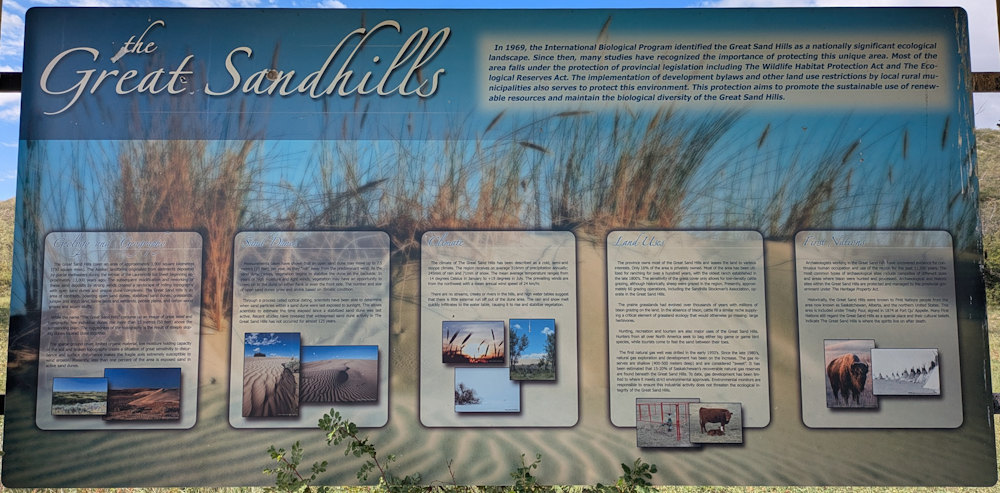


The parking lot is also the trailhead for a couple of foot-trodden trails in the sand heading out to the dunes. These trails meander through the grasslands and eventually up onto several of the dunes. In fact, one trail immediately ascends a large dune bringing hikers to the Hanging Cowboy Boots display.

All About the Great Sand Hills
The most striking observation you’re likely to make, aside from the endless sky, is the lack of exposed sand dunes. There are many dunes around, but most of them are overgrown with vegetation. If, like me, you were expecting a desert esthetic, this might be a disappointment. Sahara in Saskatchewan, this is not.

That little reality is soon forgotten once you get onto an open dune and start taking it all in. For starters, the surrounding views are incredible, both in size and simplicity. We were at the Great Sand Hills on a partly cloudy day and the fluffy white clouds lazily traversing the blue sky with rolling green and beige hills below made for outstanding panoramas.


The sand, too, is fascinating. Known as rock flour, this finely ground sand is the pulverized remains of sand deltas deposited in former glacial Lake Bursary. It’s remarkably soft. You can’t resist the temptation to sift it through your fingers over and over again, toss it in the air, or induce small landslides down the faces of the dunes. Had my family not been present, I might have even bathed in the stuff!


I’m not sure how the local critter population would have reacted to such antics. We didn’t see many, but evidence of their existence was seemingly everywhere. Various tracks crisscrossed the dunes revealing an active mammal and insect nightlife. At one point, we captured a black beetle scurrying for safety but no such luck seeing any mammals. Unless you count the cows grazing in the distance.
Wildflowers and native prairie berries and grasses added colour to the surroundings. I’m sure there are times of the year when this display is more dramatic, but even in late July it was pretty, if muted.


We explored and played for a couple hours before heading onward to Saskatchewan Landing. What some might view as an unnecessary detour in the midst of our camping trip was a delightful experience. There is genuine beauty in the subtlety and solitude of a place like the Great Sand Hills. It’s a pity you can’t camp there. The skygazing at night would be phenomenal.
If you’re ever traveling through southwest Saskatchewan, be sure to add the Great Sand Hills to your itinerary.
Thanks for your review. I visited the Great Sand Hills (twice) over the last decade and I think that they are fabulous. They are emblematic of all of those places in Canada that we just know nothing about because the TCH doesn’t run past them and it’s just the prairies, anyway.
Saskatchewan is particularly overlooked. East block of Grasslands NP – my favourite – and West Block too are wonderful. I almost hate to mention them because they are so scenic and fabulous and yet you can visit and camp without having to book six months in advance.
Saskatchewan does get overlooked a lot, unfortunately. I always find myself in awe at places like Great Sand Hills and Grassland NP imagining what it was like for the first settlers who came there thinking they were about to begin a new life. And the First Nations people who called these places home but were wise enough to keep moving around, following the seasons and their food.
I appreciate your reply. You are probably aware of it, but may I recommend to your readers:
Wolf Willow: A History, a Story, and a Memory of the Last Plains Frontier: by Wallace Stegner. An engagingly written memoir by a child of settlers in Eastend SK.
Thanks. I’ll check that out.